

The Ozempic® pen is Novo Nordisk's once-weekly, multi-dose injection pen for semaglutide, FDA-approved to improve blood sugar in adults with type 2 diabetes (and to reduce the risk of major complications in adults with type 2 diabetes and known heart or kidney disease). Unlike single-use pens, one Ozempic® pen holds several weekly doses — which means there's slightly more to learn up front: you attach a needle each time, run a one-time flow check when using a new pen, and dial your dose before injecting. This guide walks through each step in plain language.
Read this first
This is general education, not medical instruction. Always follow the official Instructions for Use that come in your Ozempic® carton and any guidance from your prescribing clinician — they override anything here. If you're unsure at any step, stop and message your provider before injecting.
Before you start: know your pen
Ozempic® comes in three different strengths, color-coded by label:
- Red label — delivers 0.25 mg or 0.5 mg doses. This is the starter pen: a typical schedule uses four 0.25 mg doses, then two 0.5 mg doses from the same pen (six doses total). Alternatively, this pen can deliver four 0.5 mg doses.
- Blue label — delivers 1 mg doses (four per pen).
- Yellow label — delivers 2 mg doses (four per pen).
Check the label and the color before every injection — during dose changes it's easy to have two strengths in the fridge. Each carton includes NovoFine® Plus needles (32G, 4 mm — very short and thin): six needles in the starter carton, four in the others. You'll also want an alcohol swab and a sharps disposal container.
Step by step
- Wash your hands. Wash thoroughly with soap and water before handling the pen or needle.
- Check the pen and medicine. Confirm the label shows Ozempic in the strength your clinician prescribed and that it isn't past the expiration date. The liquid in the window should be clear and colorless — don't use it if it's cloudy, discolored, or has particles in it.
- Attach a new needle. Tear the paper tab off a new needle, push it straight onto the pen and twist until tight, then remove both the outer and inner needle caps. Keep the outer cap — you'll use it to remove the needle afterward. Use a fresh needle for every injection.
- Do the flow check (new pens only). Before the first injection with a new pen, turn the dose selector to the flow-check symbol, then press and hold the dose button until the counter shows 0. A drop of medicine should appear at the needle tip. If it doesn't after repeating per the Instructions for Use, change the needle and try again — and don't use a pen that never shows a drop.
- Dial your dose. Turn the dose selector until the dose counter shows your prescribed dose. Confirm the number matches your prescription before going further — the counter, not the clicks, is the measure.
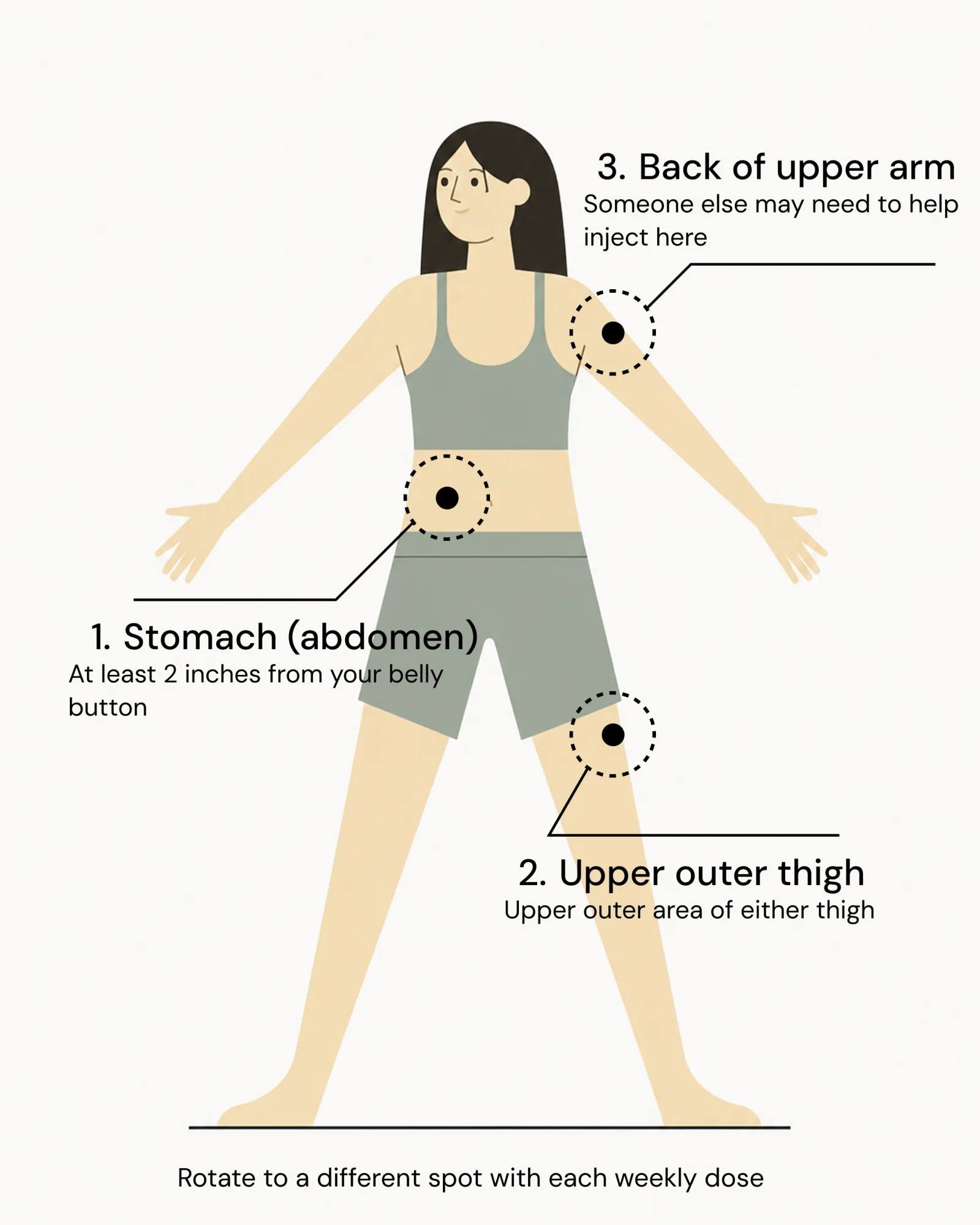
- Choose and clean a site. Use a different spot than last week, wipe the site with an alcohol swab, and let the skin dry. Inject into the abdomen (at least two inches from the belly button), the front of the thigh, or the back of the upper arm.
- Inject and hold. Insert the needle into your skin and press and hold the dose button until the counter returns to 0 — then keep the needle in and count slowly to 6 so the full dose is delivered. Releasing or withdrawing early can mean a partial dose.
- Remove the needle and store the pen. Remove the needle from your skin and release the button. (If you bleed, apply gentle pressure with a cotton ball or gauze pad — don't rub.) Carefully guide the used needle into its outer cap without touching it, twist the needle off, and drop it in a sharps container. Recap the pen — storing it with a needle attached can leak medicine — and note the first-use date: the pen is discarded 56 days after first use.
Where to inject (and rotating sites)
The three approved injection areas are the abdomen (at least 2 inches from your belly button), the front of the thigh (either thigh), and the back of the upper arm (someone else may need to help you inject there). Rotate to a different spot each week — repeated same-spot injections can cause lumps or irritation that affect how the medication absorbs.
About those "click charts" you may have seen online
Because the Ozempic® dose selector clicks as it turns, unofficial "click charts" circulate online claiming you can count clicks to measure doses the pen doesn't display. Don't. The pen is engineered and FDA-reviewed to deliver its marked doses accurately — the dose counter is the only reliable measure, and the clicks are not a dosing instrument. Improvised doses can be meaningfully wrong in either direction. If you and your clinician decide you need a dose the pen doesn't offer, that's a prescription change, not a counting exercise.
Storing the Ozempic pen
- Before first use: keep pens refrigerated at 36–46°F. Never freeze a pen — if one freezes, throw it away even after it thaws.
- In use: after the first injection, the pen can be kept at room temperature (59–86°F) or in the refrigerator. Either way, discard it 56 days after first use, even if medicine remains. Writing the first-use date on the label makes this easy.
- Always: keep the pen cap on when you're not injecting (the medicine is light-sensitive), remove the needle after each injection rather than storing the pen with a needle attached, and keep it out of reach of children and pets.
Common mistakes to avoid
- Skipping the flow check on a new pen. It's how you confirm the pen works and the needle isn't blocked. Check the flow right before using a new pen for the first time only — repeating it every week wastes medicine.
- Storing the pen with a needle attached. It can leak medicine and let air into the cartridge. Needle on, inject, needle off.
- Reusing needles. A fresh needle every time reduces pain, clogging, and infection risk — you have a fresh one in the carton for every dose.
- Letting go too early. Press and hold the dose button until the counter returns to 0, then count slowly to 6 before withdrawing. Releasing early can mean a partial dose.
- Dialing from memory. Confirm the number in the dose counter matches your prescription every single week — especially if you keep more than one strength at home.
- Using a pen past 56 days. Even a pen with visible medicine left gets discarded 56 days after first use.
When to call your provider
Reach out to your clinician if you notice signs of an allergic reaction (swelling, trouble breathing, severe rash), persistent severe abdominal pain (which can signal pancreatitis), a hard lump or infection at the injection site, or if you've missed doses and aren't sure how to get back on schedule. With Pallas, you can message your care team directly without booking a visit.
Using a different device? See our step-by-step guides to the Wegovy® pen and the Zepbound® KwikPen.
Bottom line: The Ozempic® pen asks a little more of you than a single-use pen — attach a fresh needle, flow-check each new pen once, dial and confirm your dose, hold for the full count, and track the 56-day clock. After the first week or two it takes under a minute. Keep your Instructions for Use handy, and message your provider any time you're unsure.