

Zepbound® — Eli Lilly's once-weekly tirzepatide, FDA-approved for chronic weight management — doesn't only come as a pen. Lilly also sells it in single-dose vials, most commonly through its LillyDirect self-pay pharmacy channel, where the vial form is typically the lower-cost cash-pay option. The trade-off: instead of a pre-loaded device, you draw your dose from the vial with a syringe yourself. It sounds more intimidating than it is — the single-dose vial contains exactly one dose, so there's no measuring math to get wrong. This guide walks through every step.
Read this first
This is general education, not medical instruction. Always follow the official Instructions for Use that come with your Zepbound® vial and any guidance from your prescribing clinician — they override anything here. Before your first injection, your provider or pharmacist should show you the technique. If you're unsure at any step, stop and message your provider before injecting.
Before you start
You'll need: your single-dose vial, a syringe and needle (these are supplied separately — for example, a 1 mL syringe with a needle your provider or pharmacist recommends), two alcohol swabs, a piece of gauze or a cotton ball, and a sharps disposal container. Set everything on a clean, flat surface.
Two things to know up front: the vial contains exactly one weekly dose — you draw up one dose (the usual amount is 0.5 mL) and discard the vial afterward, even if a little liquid remains. And you use a new syringe and needle every time — never reuse or share either.
How much do I draw? (0.5 mL, every strength)
Zepbound® single-dose vials come in six strengths, and every one of them is filled to the same 0.5 mL volume — the strength changes the concentration inside that 0.5 mL, not how much you draw. That's why there's no per-dose conversion math with the vial the way there can be with a compounded prescription: whatever strength your pharmacy dispenses, you draw the full vial, to the 0.5 mL mark (50 units, if your syringe happens to be marked in units on a standard U-100 scale).
| Prescribed strength | Vial volume | What you draw |
|---|---|---|
| 2.5 mg | 0.5 mL | Full vial, to the 0.5 mL mark |
| 5 mg | 0.5 mL | Full vial, to the 0.5 mL mark |
| 7.5 mg | 0.5 mL | Full vial, to the 0.5 mL mark |
| 10 mg | 0.5 mL | Full vial, to the 0.5 mL mark |
| 12.5 mg | 0.5 mL | Full vial, to the 0.5 mL mark |
| 15 mg | 0.5 mL | Full vial, to the 0.5 mL mark |
Never try to draw a partial volume to approximate a different dose — the single-dose vial's label doesn't support splitting or converting it. If your prescribed strength changes, your pharmacy dispenses a different vial at the new strength; you still draw that vial's full 0.5 mL. Questions about your specific dose belong with your pharmacist or care team, not a calculation.
Step by step
- Wash your hands and gather supplies. Wash thoroughly with soap and water. Set out the vial, a new syringe and needle, two alcohol swabs, gauze or a cotton ball, and a sharps container on a clean surface.
- Check the vial. Confirm the label shows Zepbound in the dose your clinician prescribed and that it isn't expired. The liquid should be clear and colorless to slightly yellow — don't use it if it's cloudy, discolored, or has particles in it, or if the vial has been frozen.
- Prepare the vial and syringe. Pull off the plastic cap and wipe the rubber stopper with an alcohol swab. Don't touch the stopper after cleaning it. Unwrap your syringe and make sure the needle is firmly attached before pulling off the needle shield.
- Draw your dose. Insert the syringe needle through the stopper, turn the vial and syringe upside down, and slowly pull the plunger down to draw one dose — the standard amount is 0.5 mL. Tap any air bubbles to the top and gently press them out, then withdraw the needle from the vial.
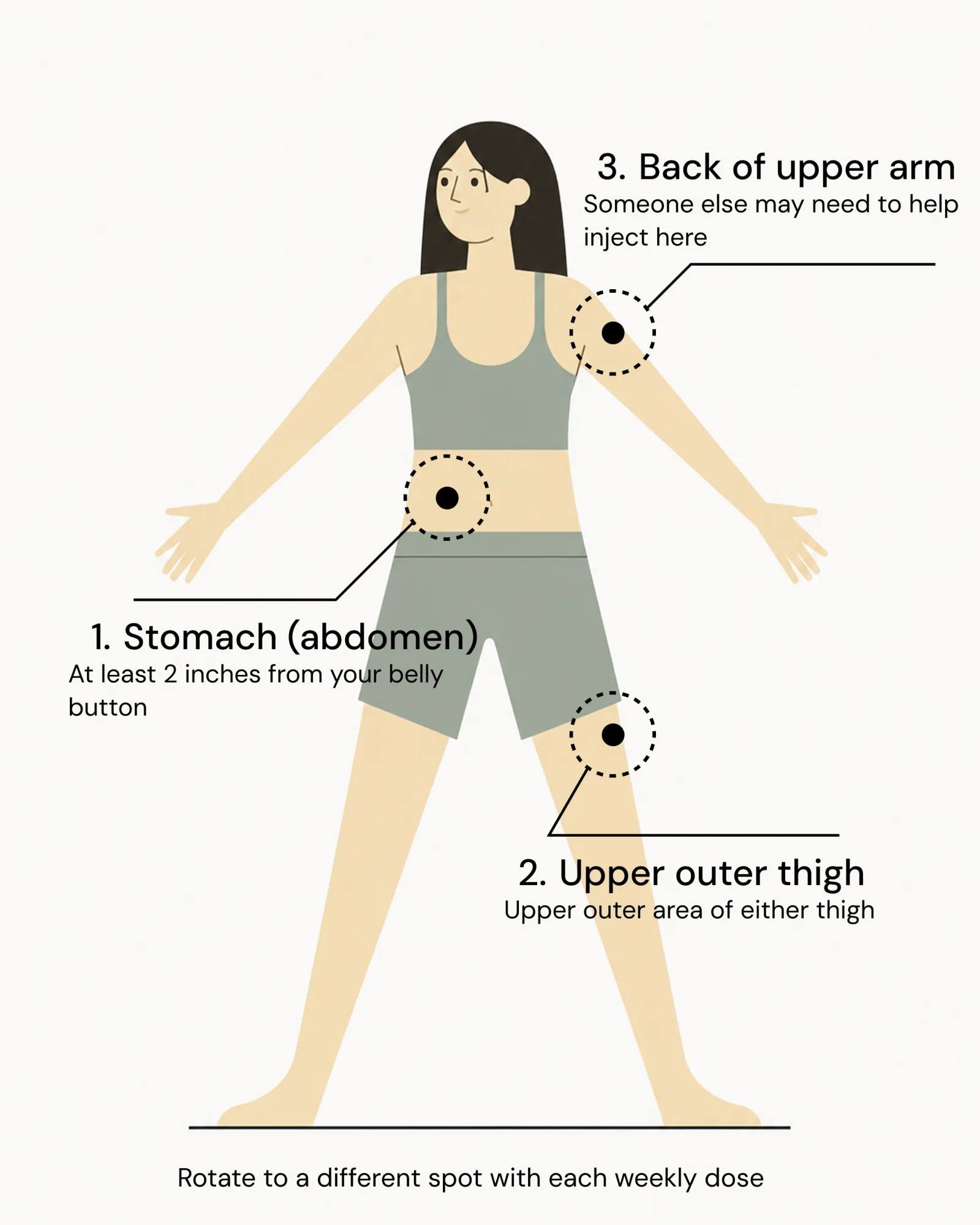
- Choose and clean a site. Choose a different injection site than last week, wipe with an alcohol swab, and let the skin dry. Inject into the abdomen (at least two inches from the belly button) or the front of the thigh; a helper can inject into the back of your upper arm.
- Inject. Insert the needle into your skin at the angle your provider showed you and push the plunger all the way down. Keep the needle in place for at least 5 seconds so the full dose is delivered, then withdraw it.
- Press — don't rub. If you bleed, press the site lightly with gauze or a cotton ball. A drop of blood is normal; vigorous rubbing isn't necessary.
- Dispose of everything sharp. The syringe and needle go straight into an FDA-cleared sharps container — never recap a used needle. Discard the vial too, even if a little liquid remains; it's single-dose.
Where to inject (and rotating sites)
The three approved injection areas are the abdomen (at least 2 inches from your belly button), the front of the thigh (either thigh), and the back of the upper arm (someone else should give the injection there). Rotate to a different spot each week — repeated same-spot injections can cause lumps or irritation that affect how the medication absorbs.
Storing Zepbound vials
Vials follow the same rules as the single-dose pens: refrigerate at 36–46°F in the original carton, never freeze (a frozen vial gets discarded even after it thaws), and if needed, an unopened vial can be kept at room temperature — up to 86°F — for up to 21 days total, after which it must be thrown away. For the full rules, including hot-car exposure and flying with your medication, see our guide to storing and traveling with Zepbound®.
Common mistakes to avoid
- Reusing the vial. It's single-dose. Once you've drawn your injection, the vial is done — discard it even if liquid remains.
- Reusing or recapping needles. A fresh syringe and needle every week; and never recap a used needle — recapping is how most needle-stick injuries happen. Straight into the sharps container.
- Skipping the stopper wipe. Cleaning the rubber stopper with an alcohol swab before inserting the needle protects the sterility of your dose.
- Leaving air bubbles in the syringe. Large bubbles displace medication. Tap them to the top and press them out before withdrawing the needle from the vial, per your Instructions for Use.
- Pulling out too fast. Keep the needle in your skin for at least 5 seconds after pushing the plunger fully so the whole dose is delivered.
- Injecting cold medication straight from the fridge. Letting the vial sit at room temp first is more comfortable.
When to call your provider
Reach out to your clinician if you notice signs of an allergic reaction (swelling, trouble breathing, severe rash), persistent severe abdominal pain (which can signal pancreatitis), a hard lump or infection at the injection site, or if you've missed doses and aren't sure how to get back on schedule. With Pallas, you can message your care team directly without booking a visit.
Using a different device? See our step-by-step guides to the Zepbound® KwikPen and the Wegovy® pen, or the guide to injecting semaglutide — pens and compounded vials.
Bottom line: The Zepbound® vial asks you to do one thing the pens do for you — draw the dose — and the single-dose design keeps that simple: wipe the stopper, draw up one dose, inject, and everything sharp goes in the sharps container. Have your provider or pharmacist walk you through the first one, and message your care team any time you're unsure.