
Your prescription says 0.25 mg once weekly. Your syringe says units. If you've stared at those two numbers wondering how one becomes the other, you're in the most common point of confusion we see from patients starting compounded semaglutide — and the answer is simpler than it looks, with one non-negotiable rule attached.
The only authoritative numbers are the ones on your pharmacy instructions and your vial label. The chart and formula below explain the math so nothing about your dose feels mysterious — but if the instructions on your pharmacy label state a number of units, follow that number. If it's missing, unclear, or doesn't match the math here, message your care team before injecting.
Why your syringe doesn't say mg
Insulin syringes — the kind that ship with most compounded semaglutide prescriptions — are marked in units, and units measure liquid volume, not medication strength. On the standard U-100 syringe:
- 100 units = 1 mL
- 10 units = 0.1 mL
- 1 unit = 0.01 mL
Your dose, meanwhile, is prescribed in milligrams (mg) — an amount of medication. The bridge between the two is the concentration printed on your vial's label, expressed in mg/mL: how many milligrams of semaglutide are dissolved in each milliliter of liquid.
That's the entire puzzle. Same dose, different concentration, different number of units.
The conversion formula
Two steps:
- Volume (mL) = your dose (mg) ÷ your vial's concentration (mg/mL)
- Units = volume (mL) × 100
Or in one line: units = mg ÷ (mg/mL) × 100.
Worked example: your prescribed dose is 0.25 mg and your vial label says 2.5 mg/mL. Then 0.25 ÷ 2.5 = 0.1 mL, and 0.1 × 100 = 10 units. Same dose with a 1 mg/mL vial: 0.25 ÷ 1 = 0.25 mL = 25 units. Same milligrams, entirely different syringe reading.
Prefer not to do arithmetic before a needle? Our dose calculator does exactly this: enter your prescribed mg and the concentration from your vial label, and it shows the volume and where that lands on a U-100 syringe.
However, you usually won't need to do any math or conversions yourself. The compounding pharmacy should provide accompanying instructions with your medication. Typically, the vial of compounded semaglutide will come in a prescription bottle or carton, with your instructions right on the label. If it's missing or unclear, it's always better to check with your care team than risk using the wrong dose.
Semaglutide units-to-mg conversion chart
Compounding pharmacies commonly dispense semaglutide at concentrations like 1 mg/mL, 2.5 mg/mL, or 5 mg/mL — and the concentration can change when your dose steps up, even at the same pharmacy. This chart shows how the same prescribed dose reads in units at each of those concentrations on a U-100 syringe:
| Prescribed dose | 1 mg/mL vial | 2.5 mg/mL vial | 5 mg/mL vial |
|---|---|---|---|
| 0.25 mg | 25 units | 10 units | 5 units |
| 0.5 mg | 50 units | 20 units | 10 units |
| 1 mg | 100 units | 40 units | 20 units |
| 1.7 mg | — | 68 units | 34 units |
| 2.4 mg | — | 96 units | 48 units |
The dashes matter: at 1 mg/mL, doses above 1 mg would exceed a full 1 mL syringe. If your math ever produces a number larger than your syringe holds, stop — that's a signal to call your pharmacy, not to improvise with multiple draws.
This chart is illustrative, not a dosing instruction. It cannot know your vial's concentration — check your vial label to confirm that. Different patients on the same 0.25 mg dose can have correct syringe readings of 5, 10, and 25 units depending on their vial concentration. Never copy another patient's units from a forum, group chat, or well-meaning friend.
How to read the syringe
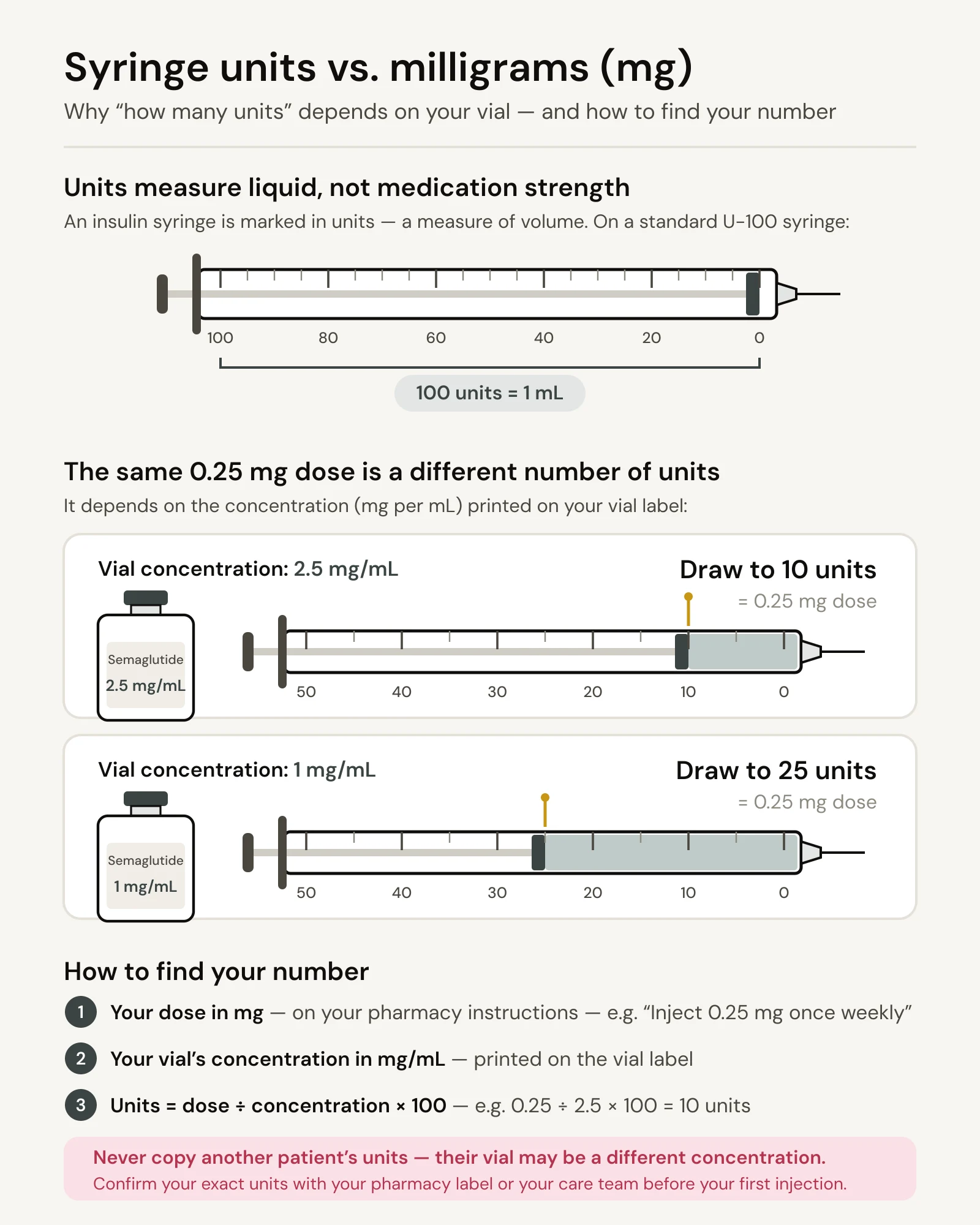
Draw the plunger until the top edge of the rubber stopper sits exactly on your unit line, with no air bubbles above it. Small syringes usually mark every unit or every 2 units; confirm which yours uses before your first draw. For the full draw-and-inject technique — including how to clear air bubbles — see our step-by-step semaglutide injection guide.
Where brand-name pens fit in
None of this math applies to the FDA-approved pens. Wegovy® pens and Ozempic® pens come with their own step-by-step instructions to follow. The units question exists specifically because compounded semaglutide is typically dispensed as a vial + insulin syringe, which is also why it's worth mastering: it's the one piece of technique the pen users don't need to worry about.
Compounded semaglutide is prepared per-patient by a compounding pharmacy and prescribed when a licensed clinician determines it's appropriate; it is not FDA-approved, and which form is right for you is a decision you make with your clinician.
The same math works for tirzepatide
If you're on compounded tirzepatide, the identical two-step formula applies: mg ÷ (mg/mL) × 100. Only the numbers on your label change.
Think of it like a measuring cup — it measures the amount of liquid the same way whether you're pouring a cup of water or juice. Similarly, your syringe measures a volume of liquid, and the type of medication doesn't change how you read it.
Frequently asked questions
It depends entirely on your vial's concentration, printed on its label. On a standard U-100 insulin syringe, 0.25 mg is 10 units with a 2.5 mg/mL vial, 25 units with a 1 mg/mL vial, and 5 units with a 5 mg/mL vial. The formula is units = mg ÷ (mg/mL) × 100. Because concentrations differ between pharmacies — and can change when your dose steps up — always confirm the number against your own pharmacy instructions and vial label, and never copy another patient's units.
Two steps: divide your prescribed dose in mg by the concentration on your vial label in mg/mL to get the volume in mL, then multiply by 100 to get units on a U-100 syringe. Example: 0.5 mg ÷ 2.5 mg/mL = 0.2 mL = 20 units. Our free dose calculator at pallashealth.co/tools/dose-calculator does the math and shows where the dose lands on the syringe.
At 2.5 mg/mL, 0.5 mg is 20 units; at 1 mg/mL it's 50 units; at 5 mg/mL it's 10 units — all on a U-100 syringe. The vial concentration is the deciding number, so check your label and pharmacy instructions rather than assuming.
On a standard U-100 insulin syringe, yes — 100 units equal 1 mL, so 10 units equal 0.1 mL. Units measure liquid volume, not medication strength, which is exactly why the same mg dose can be a different number of units from one vial to the next.
Your prescription states an amount of medication (milligrams); your insulin syringe measures an amount of liquid (units, where 100 units = 1 mL). The concentration on your vial — how many mg are dissolved in each mL — is the bridge between the two. Pharmacies dispense compounded semaglutide at different concentrations, so the units number is personal to your vial.
Yes. Units measure volume regardless of the medication, so the identical formula applies: units = mg ÷ (mg/mL) × 100. Only the dose and concentration on your tirzepatide label change the numbers.
References
Syringe technique and dosing guidance follow the instructions dispensed with your prescription; brand-name device guidance follows the FDA-approved Instructions for Use. Always follow the specific instructions that ship with your medication.
- U.S. Food and Drug Administration. WEGOVY® (semaglutide) prescribing information. 2026.
- U.S. Food and Drug Administration. ZEPBOUND® (tirzepatide) prescribing information. 2026.
- National Academies of Sciences, Engineering, and Medicine; Health and Medicine Division; Jackson LM, Parker RM, Mattison DR, editors. Regulatory Framework for Compounded Preparations. In: The Clinical Utility of Compounded Bioidentical Hormone Therapy: A Review of Safety, Effectiveness, and Use. Washington (DC): National Academies Press (US); 2020.
Bottom line: units = mg ÷ (mg/mL) × 100, and the concentration on your vial label is the number that makes or breaks the math. Do the calculation once, confirm it against your pharmacy instructions, and message your care team if anything disagrees — thirty seconds of checking beats any amount of guessing.
Dose questions answered by clinicians
Pallas patients can message their care team directly with dosing and syringe questions — most get an answer the same day.
Start your intake →