
The Mounjaro® pen is Eli Lilly's once-weekly, single-dose injection pen for tirzepatide, FDA-approved to improve blood sugar in adults with type 2 diabetes. Like other single-dose devices, it's built to keep the process simple: each pen contains exactly one preset dose, the needle stays hidden the whole time, and there's no priming step and nothing to dial. If your first pen just arrived, this guide walks through every step in plain language.
Read this first
This is general education, not medical instruction. Always follow the official Instructions for Use that come in your Mounjaro® carton and any guidance from your prescribing clinician — they override anything here. Mounjaro® is also available as a multi-dose KwikPen® that holds four weekly doses and works differently from the single-dose pen covered here (similar to the Zepbound® KwikPen). If your carton says KwikPen, follow the instructions that come with that device instead. If you're unsure at any step, stop and message your provider before injecting.
Before you start
You'll need: your Mounjaro® pen, an alcohol swab, and a sharps disposal container. The needle is enclosed inside the pen and never needs attaching, and because each pen is single-use with a preset dose, there's no dial to turn.
Mounjaro® comes in six dose strengths (2.5 mg, 5 mg, 7.5 mg, 10 mg, 12.5 mg, and 15 mg). The pens you receive match your current step on the titration schedule your clinician set — check the strength printed on the label before every injection, especially during a dose change, when it's easy to have more than one strength on hand.
Step by step
- Wash your hands. Wash thoroughly with soap and water before handling the pen.
- Check the pen and medicine. Confirm the label shows Mounjaro in the strength your clinician prescribed, and that it isn't past the expiration date. The liquid should look clear and colorless or slightly yellowish — don't use it if it's cloudy, discolored, has particles in it, or the pen looks damaged or has been frozen.
- Let it reach room temperature. If the pen has been refrigerated, leave the base cap on and let it sit out for the time noted in your Instructions for Use — this can make the injection more comfortable.
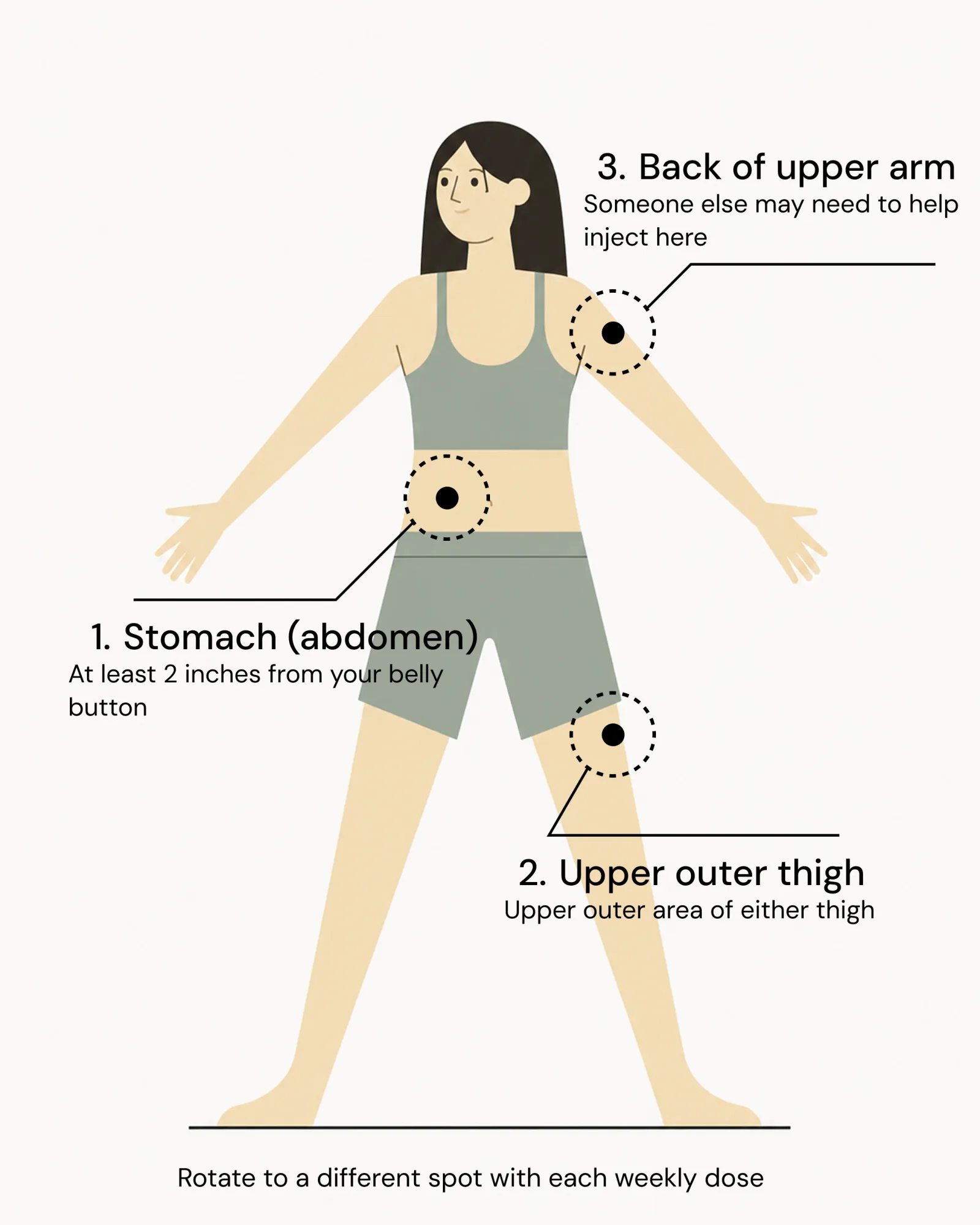
- Choose and clean a site. Inject into the abdomen (at least two inches from the belly button) or the thigh; a helper can inject into the back of your upper arm. Move to a different spot than last week, wipe the site with an alcohol swab, and let it dry.
- Remove the base cap. Pull the gray base cap straight off only when you're ready to inject, and throw it away in household trash — don't put it back on, which can damage the needle.
- Unlock and position the pen. Turn the pen's lock ring to unlock it, then place the clear base flat against your cleaned injection site.
- Press and hold. Press and hold the purple injection button. Keep the pen in place until the gray plunger becomes visible in the window — per the Instructions for Use, this can take up to 10 seconds — which confirms your full dose was delivered.
- Dispose of the whole pen. Lift the pen straight off and place the entire used pen in an FDA-cleared sharps disposal container. Each pen is single-use — never save or reuse one.
Where to inject (and rotating sites)
The three approved injection areas are the abdomen (at least 2 inches from your belly button), the thigh, and the back of the upper arm (someone else may need to help you inject there). Move to a different spot within your chosen area each week — injecting the exact same spot repeatedly can cause lumps or irritation that affect how the medication absorbs.
The dose schedule, briefly
Mounjaro® is titrated: treatment typically starts at 2.5 mg weekly, a dose meant to help your body adjust rather than to manage blood sugar on its own, and steps up gradually — usually every four weeks — toward the dose your clinician targets. Don't skip steps or move up on your own. Your prescriber sets the pace, and it's normal for them to hold a step longer if you're having side effects.
Storing the Mounjaro pen
- Before use: keep pens refrigerated at 36–46°F, in the original carton to protect them from light. Never freeze a pen — if one freezes, throw it away even after it thaws.
- Room temperature: if needed, an unused pen can be kept at up to 86°F for up to 21 days. After 21 days out of the fridge, discard it — returning it to the refrigerator doesn't reset the clock.
- Always: keep the cap on until you're ready to inject, and store pens out of reach of children and pets.
Common mistakes to avoid
- Skipping the unlock step. The pen has a lock ring that must be turned before the injection button will work — this is a deliberate safety feature, not a malfunction.
- Not holding long enough. Pulling the pen away before the gray plunger is visible can mean an incomplete dose. Hold until your Instructions for Use confirm the injection is done.
- Recapping the base after removing it. Once the gray base cap is off, don't put it back on — doing so can damage the needle. It goes in household trash, not the sharps container (the needle itself never touches it).
- Skipping site rotation. Same-spot injections lead to lumps and uneven absorption.
- Mixing up pen strengths. During dose changes, check the label every time rather than going by pen color or memory alone.
When to call your provider
Reach out to your clinician if you notice signs of an allergic reaction (swelling, trouble breathing, severe rash), persistent severe abdominal pain (which can signal pancreatitis), a hard lump or infection at the injection site, or if you've missed doses and aren't sure how to get back on schedule. With Pallas, you can message your care team directly without booking a visit.
Using a different device? See our step-by-step guides to the Wegovy® pen, the Ozempic® pen, and the Zepbound® KwikPen, or the guide to injecting semaglutide — pens and compounded vials.
Bottom line: The Mounjaro® single-dose pen is a hidden-needle autoinjector — check the pen, clean a site, remove the base cap, unlock and press until the gray plunger appears, then dispose of the whole pen in a sharps container. Keep your Instructions for Use handy, rotate sites weekly, and message your provider any time you're unsure.